For many years, airlines have prospered from growing air travel demands, cost cutting measures and employing better capacity management. Benefiting from the overall growth in economic prospects, airline investors who bought shares in 2009 would have received a total return of more than 150% in 2018, before witnessing a sharp drop in profits in the recent months in 2020 (see Figure 1).
Figure 1: Airlines have delivered growth prior to Covid-19
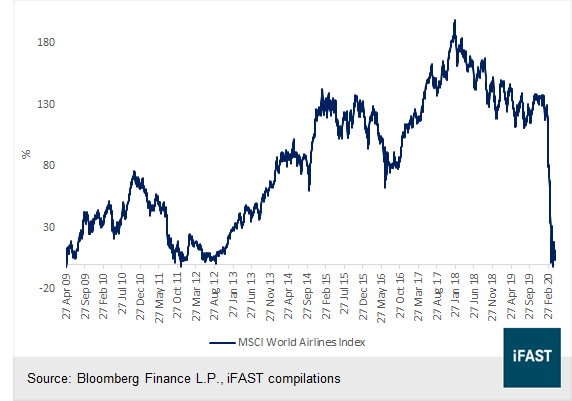
Growth in the airline industry came to a stiff halt amid the Covid-19 pandemic, forcing airlines to reduce operations drastically. The International Air Transport Association (“IATA”) projects a 55% fall in passenger revenues for 2020 and revenue passenger kilometres (“RPK”) is also expected to drop 48% YoY.
Air cargo transportation volumes could decrease. IATA expects an average decline of 31% in air cargo tonne kilometres flown this year, assuming a pessimistic economic scenario forecasted by the World Trade Organisation (“WTO”). In the pessimistic scenario, the WTO foresees a 31.9% contraction in global trade volume, with a steep initial decline and a prolonged and incomplete recovery.
Airlines have been facing spectrum of problems that are hard to resolve, or strenuous to balance out their impacts. Rising international competition, volatile fuel prices, heavy costs for managing capacity and aircraft maintenance have all threatened profitability. Exogenous factors affecting jet fuel prices such as rapidly changing geopolitical grounds and unforeseen global shocks exacerbate the complications, leaving many small airline players grappling with low revenues.
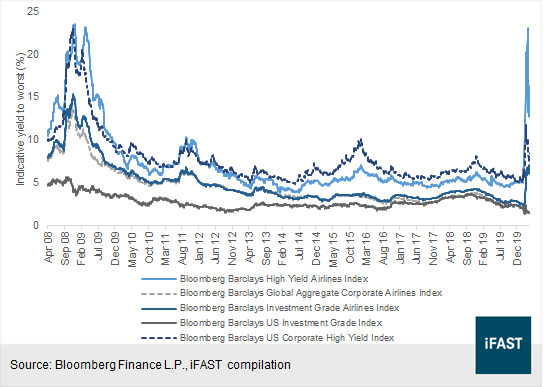
Corporate borrowing costs have increased in the aviation industry. Airline bond yields have surged to a level last seen in the Global Financial Crisis (“GFC”) period during 2008 (see Figure 2). But these surging bond yields are investment opportunities as we believe aviation will remain an irreplaceable mode of transport connecting people and goods to their intended locations in the quickest way possible so travel demand will likely keep the airline sector buoyant in the long term.
Figure 2: Airline bond yields have spiked to GFC levels
Prices of airline
bonds have dipped (yields surged) but investors may consider looking at issuers
with decent financial strength and a healthy debt servicing capability. In this
article, we discuss about the credit aspects of the industry, the potential
impact of the Covid-19 situation and how airlines will cope with the global headwinds.
We also identify rare gems in the sector that have outperformed other peers who
are able to cover their interest expenses.
Revenue: it’s not just about flying people and goods
Competition within the aviation sector has prompted airlines to identify their own competitive edge through product differentiation. Besides selling flight tickets, airlines have gradually introduced variations of their revenue mix. Passengers are being charged, at their discretion, for services such as on-demand entertainment, in-flight services and extra baggage.
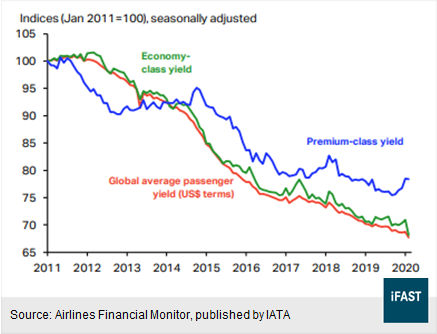
Airfares according to various categories have made a varied impact to an airline’s total revenue. First class and business class flyers pay higher prices than economy class passengers to enjoy premium services in an elite section of the aircraft. Figure 3 indicates that premium-class passenger yields have held up better than those in the economy cabin in recent months as demand for first-class and business-class tickets is typically less price sensitive.
Figure 3: Premium-class yield are higher than economy class yield
In the near term, there is no avoiding of plummeting demand in view of the recently enforced social distancing measures, where travel bans and city lock-downs across the world have slashed the number of scheduled flights. In its fourth Covid-19 impact assessment, IATA expected a 48% fall in RPK YoY, translating to a loss of USD314 billion of passenger revenue for the entire industry.
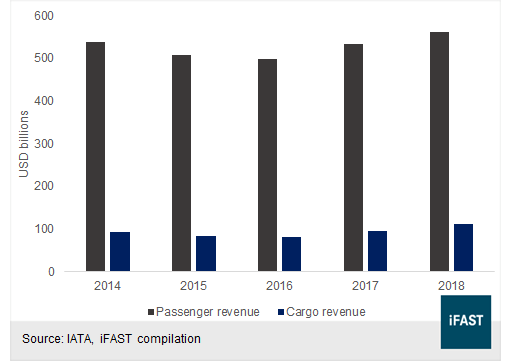
Cargo revenue may help to offset the drop in passenger revenue, but only to a small extent as a sharp decline in economic activity and global recession would have also taken a toll on freight demand. On average, cargo revenue made up 14.9% of total revenue from global commercial airlines from 2014 to 2018 (see Figure 4).
According to IATA, air freight had a difficult 2019 due to poor demand. Nonetheless, WTO expects a double-digit rebound in economic activity in 2021, which will lead to a recovery in air freight movement.
Figure 4: Global commercial airlines revenue from 2014 to 2018
Most countries around the globe are in lock-down and international travel is widely restricted as a measure to contain the spread of the coronavirus. China on the other hand, being the first country to experience a virus outbreak, has lifted lockdown measures in Wuhan, permitting domestic flights for residents to travel within China. That said, normal life before the pandemic is still distant. Reportedly, one has to complete a pile of paper works, undergo health tests and seek approvals from various organisations before taking a flight–and aircrafts are not completely filled with passengers as they were before.
With China possibly leading the global recovery, and giving a glimpse of what demand is like after flattening the curve, we think that the recovery in aviation will likely occur in a few stages, with domestic travel to open first before international travel.
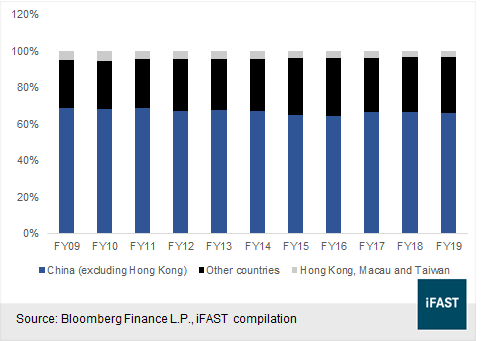
Among the airline issuers in the SGD bond market, we see China Eastern Airlines Corporation Ltd (“CEA”) possibly leading a recovery ahead of Singapore Airlines Ltd (“SIA”) and Cathay Pacific Airways Ltd (“CPA”) given that it had a large portion of revenue generated from domestic flights (see Figure 5). SIA and CPA, which have a greater reliance on international travel are likely to register losses for a relatively longer period until travel restrictions are eased globally.
Figure 5: Geographical segment of CEA by revenue
Fuel prices and hedging practices
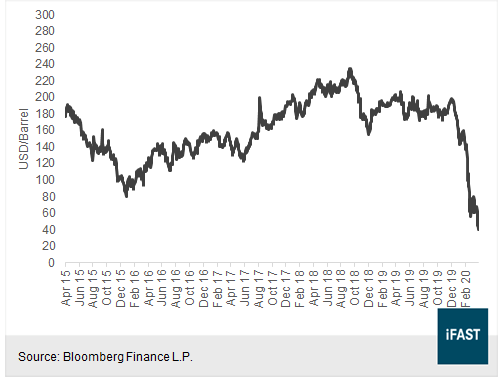
As demand collapsed, airlines have taken swift and drastic steps to manage costs. With airplanes grounded at the airports, many carriers have managed to save variable costs (i.e. those directly related to flight operations) such as landing fees and catering. Significantly lower oil prices (See Figure 6) should also help to reduce fuel expenses remarkably.
Figure 6: Jet fuel prices fell sharply
However, not all airlines stand to benefit from low fuel prices. Depending on its hedging practice, airlines that have entered into derivative contracts to lock in at a higher fuel purchase price may face losses in the near term. As shown in Table 1 below, airlines like CEA who do not hedge against fuel prices are likely to benefit from the low fuel price environment to a greater extent than the other airlines.
Table 1: Hedging practices of various carriers in the near term
|
Airline |
Description of hedging practice |
|
CEA |
CEA does not hedge fuel expenses |
|
SIA |
Q4 FY19/20 ending 31 Mar 20: 79% of jet fuel hedged at an average hedge price of USD76/barrel FY20/21: 51% hedged at an average hedge price of USD74/barrel |
|
CPA |
1Q20 to 4Q20: about 40% of fuel requirements hedged at an average strike price of USD61 to 65 per barrel |
|
All Nippon Airways |
30% and 25% of expected fuel consumption hedged for FY19 and FY20 respectively (financial year ending March), applicable only to domestic flights. No hedging of fuel expenses for international operations. |
|
Source: Company filings |
|
On the other hand, airlines like SIA that have a high hedging ratio (see article “SIA bonds: a great way to earn stable income”) are unlikely to take advantage of the significantly lower jet fuel prices. We note that for the quarter ending March (“4QFY19/20”), 79% of SIA’s jet fuel requirements were hedged at an average price of USD76 per barrel. For FY20/21, 51% of fuel requirements will be hedged at a price of USD74 per barrel. Given the difference between the hedged jet fuel price and spot price of USD60 per barrel as at 31 Mar 20, we expect SIA to likely record marked-to-market losses on its fuel hedging positions for the immediate upcoming quarters.
CPA will likely incur hedging losses like SIA. Per its FY19 (ended 31 Dec 19) results, CPA hedged about 40% of its expected fuel consumption for the remainder of this year at an average strike price in the range of USD61 to USD65 per barrel.
Hence, airlines may not benefit from low fuel prices at all times as they are dependent on the company’s hedging practice. As a heavy jet fuel user, airlines will consistently have to manage fuel expenses in order to maintain healthy operating margins.
Managing labour costs
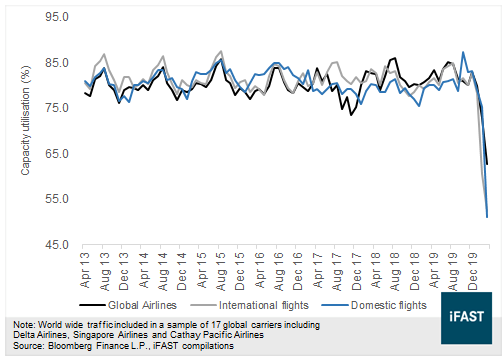
In a Bloomberg survey of 51 airlines, which collates the financial and operating data of global carriers including Air Canada, United Airlines, Delta Airlines, Deutsche Lufthansa, Air France and Singapore Airlines, labour costs accounted for a substantial portion (see Figure 7) of fixed costs next to fuel expenses. With a drop in load factors (see Figure 8), airlines have been aggressively adopting salary-cuts and extended unpaid leaves to minimise manpower costs. This would help to mitigate losses to the bottom line and increase the chances of survival at this crucial period where preserving liquidity is a top priority.
Figure 7: Fuel and wages are the two biggest operating costs for airlines
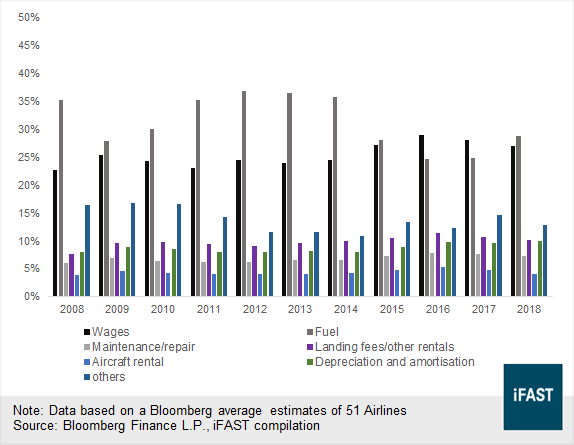
Figure 8: Plunge in load factors for international and domestic flights
Unlike employee costs, maintenance expenses are somewhat semi-fixed expenditures in our opinion as aircrafts have to be maintained periodically independent of their flight schedules. According to IATA, global spending on maintenance, repair and overhaul was valued at USD69 billion in 2018, representing about 9% of airline operating costs. The grounding of the aircraft fleet provides cost savings as virtually all the variable portion of technical-related expenses will be delayed until travel bans are subsequently eased.
New accounting treatments are unlikely to affect debt analysis
Aside from technical costs, depreciation policies also play a role in affecting profitability. Generally, aircraft assets have been depreciated using an assumed useful life of between 15 to 25 years based on observations by IATA (see Table 2). Every year, airlines recognise a significant amount of depreciation costs on its financial results to account for the decreasing value of these used aircrafts (aircrafts typically has a residual value of 0 to 20%).
Table 2: Examples of depreciation policy of airlines
|
Airline |
Aircraft/ Fleet type |
Useful Life (years) |
Residual Value (%) |
Depreciation Rate (%) |
|
Air China |
Core parts |
15 to 30 |
5 |
3 to 6 |
|
Airframe and cabin refurbishment |
5 to 12 |
- |
8 to 20 |
|
|
Overhaul of engine |
2 to 15 |
- |
7 to 50 |
|
|
Rotatable parts |
3 to 15 |
- |
7 to 33 |
|
|
Air France-KLM Group |
Not specified |
20 to 25 |
- |
4 to 5 |
|
Cathay Pacific Airways |
Passenger |
20 |
10 |
5 |
|
Freighter |
20 to 27 |
10 to 20 |
3 to 5 |
|
|
Aircraft products |
5 to 10 |
- |
10 to 20 |
|
|
Freighter converted from passengers |
10 |
- |
10 |
|
|
Singapore Airlines |
Passenger |
15 to 20 |
5 to 10 |
5 to 6 |
|
Freighter |
20 |
5 |
5 |
|
|
Used freighter |
20 less age of aircraft |
5 |
5 |
|
|
Training |
5 to 15 |
10 to 20 |
5 to 18 |
|
|
Simulators |
5 to 10 |
- |
10 to 20 |
|
|
Source: IATA, IFAST compilation |
||||
As shown in Figure 7 above, depreciation accounted for about 7 to 8% of total operating expenses. However, depreciation expenses reported on company financials have evolved in recent years to include a substantial amount of aircraft leases expenses.
With the newly introduced changes to accounting standards that have taken effect from 1 Jan 19, airlines are required to classify off-balance sheet operating leases as “right-of-use” assets with corresponding lease liabilities. As such, “depreciation” expenses have ballooned with the recognition of aircraft lease expenses.
Another area that was affected due to the new accounting treatment are finance leases, which are now included in reported interest expenses on the individual airlines’ finance costs. As with many other accounting changes, accounting standards are formulated mainly to reshape financial reports with an aim to increase reporting quality rather than impacting actual cash flows.
Adjustments would have been made to account for operating leases (which were in the past kept “off-balance sheet”) when it comes to debt analysis of an airline. Researchers found that some debt covenants imposed on airlines have also, in varying forms, brought out the importance of monitoring the amount of operating leases such that the debt burden of the company is manageable.
The recognition of liabilities pertaining to operating leases will create more impact to low cost carriers (“LCCs”) than full service carriers as LCCs have a higher tendency to opt for renting than purchasing aircrafts for the purpose of managing liquidity. As a reference, Malaysia’s leading LCC AirAsia Group Berhad reported a net operating loss of RM457.1m in FY19 mainly due to the adoption of mandatory new accounting treatment. The result represented a sharp downturn from a RM352.7m net operating profit recorded in the previous year.
Aircraft lease expenses are another cost category that many airlines have been scrambling to reduce amid the viral pandemic. We envisage more airlines shifting to renting than buying of aircrafts, or at the minimum re-negotiate lease agreements with lessors to preserve liquidity. Airlines that own a large portfolio of aircrafts may also engage in sale and leaseback transactions for their aircrafts.
The implications for investors assessing the financial health of a company is more likely to be straightforward. In our opinion, a company’s decision to lease an aircraft is cost-driven rather than influenced by accounting practice. We think it is important to take into consideration of both “depreciation expenses” and “finance expenses” when evaluating an airline’s interest servicing capability.
Airlines have thin operating margins
Support from aviation demand alone is insufficient to solve the aforementioned pricing, cost and operating problems embedded in the airline industry. As such, the heavy cost structure have obstructed airlines from translating a surge in travel demand into profits (see illustration in Figure 9) These threats are primarily inherent to the aviation industry and we expect them to persist post Covid-19.
Figure 9: Heavy cost structure has left airlines running on thin profitability
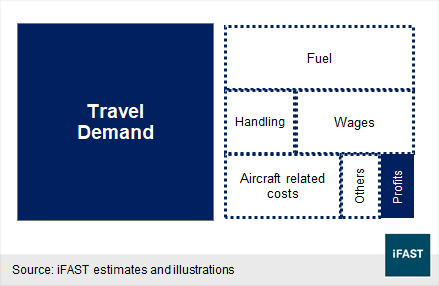
The cost-intensive nature of the industry has decreased operating margins, which reached approximately 8.6% (see Figure 10) even in their best performing year during 2016 over the past decade of travel boom. Airlines have also been losing market share to LCCs which are able to offer passenger flights at lower ticket prices. Increased competition from the LCCs have made it more difficult for carriers to pass rising costs to end customers.
Figure 10: Airlines have low profit margins
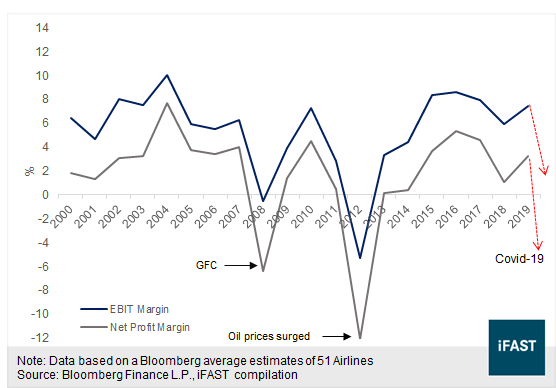
The airline industry has long been recognised as one that is highly cyclical: business travel patterns tend to be in sync with a country’s economic growth. During times of economic prosperity, household disposable income increases and individuals are more inclined to spend more on discretionary expenses such as holidays. The opposite is likely true which make airlines vulnerable to financial shocks in economic downturns. Due to the coronavirus outbreak, the aviation industry is set to face immense challenges from an unavoidable global recession (see article “Nobody knows what COVID-19 means for the future, but that shouldn’t change how you invest”).
According to IATA, economic recession alone would push global RPKs down 8% YoY in 3Q20. Global RPK growth may also sink deeper than global GDP growth. However, airlines that position themselves defensively from a possible deepening economic recession are more likely to survive through to an eventual recovery.
At this juncture, a return to international air travel is expected to be slow. Unless a vaccine is produced quickly to prevent new embers of viral outbreaks, aviation demand is more likely to recover in stages. When lock-downs and travel restrictions are eased, travel demand will still remain dependent on virus developments. Safety measures such as those of maintaining in-flight social distances or onerous pre-flight screenings may continue to hamper travel demand on the quest to full recovery.
Hence, we think individuals who are keen in investing in the aviation sector are encouraged to stick to airlines that have healthy fundamentals and adequate financial buffers to tide through a long period of low revenue.
Some examples of airlines that have been practicing a prudent financial discipline include the three airlines that were mentioned earlier, namely SIA, CEA and CPA. Between these airlines, SIA appears to have more financial headroom with a gross interest coverage without leases obligations (EBITDA/interest expenses) of 22.8x in 9MFY19/20 ended 31 December (on a trailing twelve month basis). In comparison, our estimates showed an interest coverage of 7.7x and 11.3x for CPA and CEA respectively in FY19. While we expect earnings to fall sharply due to Covid-19, these levels of interest coverage nonetheless showed a manageable financial capability of servicing interests before the global pandemic started in 2020.
As mentioned above, it is essential to also take into consideration substantial fixed charges such as lease payments when determining an airline’s interest servicing capability. Treating aircraft leases as interest payments, we find fixed charge coverage ratio (EBITDA+ lease expenses/interests and lease expenses) at 4.1x, 6.2x and 2.8x for SIA, CEA and CPA respectively.
Managing liquidity is crucial at this point in time
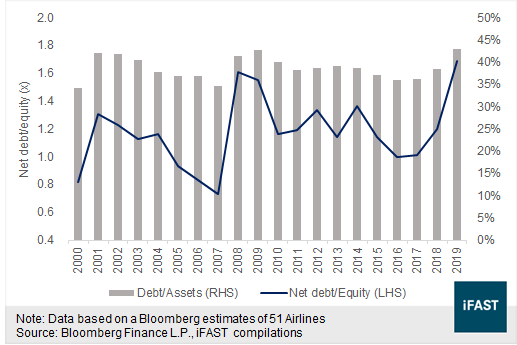
Given the trail of heavy costs that an airline has to pay and the capital intensive nature of the industry, it is thus not surprising that airlines have high debt levels (see Figure 11).
Figure 11: Debt funded growth brought airline’s debt weight to pre-GFC levels
For example, three of the airlines in Table 3 have short term obligations that exceed cash balances. These airlines have a current ratio of below 1x as shown by Bloomberg data, which suggested a greater need to monitor their liquidity risks. Liquidity becomes especially important when demand disappears, cash inflows diminishes and cash outflows continue to burn at an accelerated rate.
Therefore, the immediate challenge is to preserve cash for as long as possible until travel demand recovers. A sample of airlines listed in Table 3 showed that airlines typically have high liquidity risk.
In the near term, we think companies that have a manageable liquidity profile prior to the pandemic are more likely to sail through the Covid-19 disruptions. Particularly, we also find that Chinese airlines appear to have higher liquidity requirements than its peers as most debt obligations have to be repaid in under two years’ time.
Table 3: Airlines have high liquidity risk despite a cash generative business
|
Airline |
Current ratio (x) |
Short term debt-to-Cash (x) |
Debt-to-TTM CFO (x) |
Debt-to-TTM EBITDA (x) |
Weighted average debt distribution (years)* |
|
SIA |
0.44 |
0.80 |
2.7 |
3.1 |
4.1 |
|
CEA |
0.25 |
30.2 |
6.8 |
5.0 |
1.2 |
|
China Southern Airlines |
0.17 |
31.1 |
9.4 |
4.8 |
1.1 |
|
Air China |
0.32 |
3.20 |
3.8 |
3.5 |
1.6 |
|
CPA |
0.48 |
1.50 |
6.2 |
5.6 |
1.6 |
|
Qantas Airways |
0.41 |
0.60 |
2.4 |
2.3 |
6.4 |
|
Japan Airlines |
1.45 |
0.04 |
0.1 |
0.1 |
8.4 |
|
Air New Zealand |
0.60 |
0.51 |
3.4 |
3.6 |
5.8 |
|
*: as at 29 Apr 20 Note: TTM is the abbreviation for trailing twelve months Source: Bloomberg, iFAST estimates. Data as of 31 Dec 19 |
|||||
Against the drawback of a mounting debt load, the industry’s operating model of collecting cash from advanced bookings (before the plane takes off) has enabled airlines to achieve a stable trend of positive operating cashflows, as witnessed in the case of SIA, CPA and CEA. Notwithstanding the multitude of heavy expenses, positive streams of operating cashflows implies a cash generative business.
In addition, most airlines have also been able to generate free cash flows (“FCF”) after paying down capital expenditures from operating cashflows. In the Airlines Financial Monitor published by IATA, Asia Pacific airlines have outperformed airlines in other regions by generating the highest amount of FCFs in 4Q19 on the back of solid cash flow from operating activities.
A capital intensive industry
In this challenging environment, commercial airlines are scheduled to take delivery of over 2,206 new aircrafts which represents an investment of around USD123 billion by the industry according to research shown by IATA.
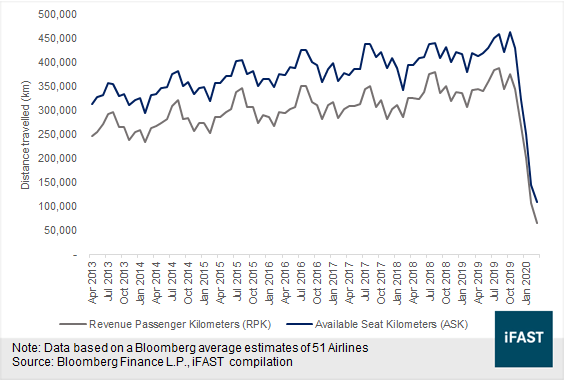
Expanding the fleet with such a large order not only adds weight to the balance sheet, but may create a hard time for the airline to fulfill capacity. As seen in Figure 12, the gap between RPK (the amount of distance travelled by passengers as a measure of demand) and ASK (a measure of passenger carrying capacity in airlines) have, while increased between 2013 and 2019, indicated that airlines had difficulty in filling up flight seats (i.e. mismatch of demand-supply). This may be a threat to profitability on a per-flight basis, and thus establishes the need for more stringent fleet planning.
Figure 12: Revenue passenger kilometre and available seat kilometre over time
Even in a period of low travel demand, airlines may still have to incur capital expenditure, be it in the form of internal upgrades, fleet expansion to retire old aircrafts or create purchase obligations. However, we expect airlines to record lower capital expenditures and spread out variable costs over a longer period. In our opinion, airlines that have a younger fleet will have more flexibility in managing capacity. For instance, airlines with a younger fleet are more likely to avoid succumbing to fleet rejuvenation compared to airlines that operate with a portfolio of aged aircrafts.
We examine the fleet plans of some Asia pacific airlines in Table 4 below. Thanks to fleet rejuvenation in recent years, most airlines have a relatively young fleet age of less than ten years. We see some cost relief from lower capital expenditures amid the ongoing Covid-19 situation. More airlines have also been cancelling their Boeing 737 Max orders this year before returning to the airspace. Apparently, the world’s two largest aircraft makers Boeing and Airbus have also seen a spike in jetliner cancellations as airlines had revised their fleet plans in response to the travel slump.
Table 4: Examples of fleet structure of airlines
|
Airlines |
No. of leased aircrafts |
Total number of aircrafts |
Average fleet age (years) |
No. of aircrafts on firm order |
No. of Boeing 737 Max |
Debt/Assets (%) |
|
SIA* |
66 |
202 |
6.5 |
165 |
6 |
25.5 |
|
CEA |
462 |
734 |
6.4 |
78 |
Under negotiation |
57.3 |
|
CPA |
120 |
236 |
9.9 |
70 |
- |
45.3 |
|
Air New Zealand |
Undisclosed |
113 |
7.1 |
10 |
- |
41.3 |
|
Air China |
413 |
699 |
7.0 |
100 |
Under negotiation |
47.5 |
|
Thai Airways |
71 |
103 |
Undisclosed |
Undisclosed |
- |
57.4 |
|
*: as at 31 Mar 19, except for Debt/Assets ratio Note: unless stated otherwise, data is as of 31 Dec 19 Source: Company filings, iFAST estimates |
||||||
Nonetheless, recent fleet revision is only temporary in our opinion. The oligopolistic nature of the aircraft manufacturing industry with only two dominant players (Boeing and Airbus) will place a high bargaining power in the hands of suppliers once travel demand recovers. Thus, managing expenses will remain an important operational task as heavy capital expenditure will continue to have an implication on debt positions.
Sovereign support has been provided to carriers
As the pandemic crisis unfolded, more and more airlines were exposed to a liquidity crunch. Cash-strapped airlines had turned to governments for financial lifelines. As far as we observed, many governments offered financial aid to help airlines tide through the crisis, but not all airlines received assistance.
Singapore’s flagship carrier SIA has recently proposed to issue rights and rights mandatory convertible bond to raise gross proceeds of S$8.8 billion. The equity fundraising was fully backed by its major shareholder Temasek Holdings who has a substantial stake of ~56% in SIA. Other than the airline itself, the Singapore government also announced a support package of at least S$750m for the country’s entire aviation sector, through wage subsidies and other measures such as funds rebate on landing and parking charges and rental relief for airlines.
Hong Kong’s Cathay Pacific Group is also reportedly set to receive a one-off HKD236m government subsidy based on the number of large carriers it has as defined by authorities. In a related measure, Hong Kong’s Airport Authority said it would buy 500,000 air tickets from its four HK-based airlines (including CPA) to directly inject cash into its local carriers as part of a HKD2 billion scheme set out for the aviation industry.
And there were others that did not manage to clinch sovereign support or are having difficulty in doing so. On 21 Apr 20, Virgin Australia Holdings Limited announced that it has entered into voluntary administration to recapitalise its business after failed attempts to obtain rescue funding from the Australia government. Even with some form of tax relief, some airlines saw its last breath anyway: UK Exeter based regional carrier Flybe entered into administration with all of its flights cancelled just two months after the government announced a rescue relief. Being a national carrier may not necessarily equate to a financial shield: Indonesia’s flagship carrier Garuda Indonesia struggled to pay its corporate bond dues.
The above examples show that airlines may approach the brink of collapse if governments do not render their support. That said, based on some examples elaborated above, we think sovereign support is not to be assumed. The possibility and extent of state financial aid needs to be examined on a case-by-case basis.
In our opinion, airlines that already have a track record of sound financial discipline prior to the virus outbreak and contribute meaningfully to the economy (such as a flagship carrier), are more likely to receive state funding, as in the case of SIA. Saving an airline is sometimes a matter of national pride: Air New Zealand avoided a financial collapse after obtaining a loan facility of NZD900m from the government, who is a 52% shareholder in the company. “New Zealand was at risk of not having a national airline,” said New Zealand’s Finance Minister Grant Robertson in a statement.
In Asia’s aviation landscape, state support is already visible for some national carriers like SIA and CPA as previously mentioned. The track record of CEA’s funding support from various state-owned units and its ultimate parent being the State Council’s State-Owned Assets Supervision & Administration Commission have also pointed to a good chance of government funding. In 2008, CEA received about RMB 7 billion of equity injection from the state-owned entity (“SOE”) CEA Holding. That financial aid came after CEA recorded a net loss of RMB 2.3 billion in the nine months ended September 2008, and was facing enormous financial pressure in the aftermath of the global financial crisis (see article “8 Things You Should Know About China Eastern Airlines and Its 2020 SGD Bond”).
Nonetheless, given the evolving and highly uncertain coronavirus developments, government aids may be a limited financial resource that provide only a temporary relief to balance sheets. In a press release by IATA, the airline association sounded gratitude towards various state support across the globe, but also voiced that more direct financial support, loans, loan guarantees for the corporate bond market by sovereign bodies are needed. “We need them to understand that without urgent relief, many airlines will not be around to lead the recovery stage. Failure to act now will make this crisis longer and more painful,” said Mr Alexandre de Juniac, CEO of IATA.
Even with the provision of liquidity relief, credit risks may continue to rise and balance sheets may be susceptible to external shocks—if financial aids are received in the form of debt. As a recap, we find that airline’s debt burden have already risen past the level last seen in the GFC period (see Figure 11).
Downturns are no stranger to airlines
However, we believe aviation transport will continue to see demand, as there is virtually no other modes of transport that is as quick as an aeroplane. The aviation industry has faced many crisis before, including the September 11 World Trade Centre terrorism attack in 2001, the Severe Acute Respiratory Syndrome outbreak in 2003 and the Global Financial Crisis in 2008. While these pale in comparison to the struggles that airlines are currently facing, history tells us that grounded planes are set to fly higher post recovery.
Predicting when the pandemic would end is difficult, but prices of aviation related securities have sank to a depressed level. We believe there are pockets of opportunities in the industry that are worth investing.
Bond ideas
Globally, bond prices of airlines companies have dropped and are reflecting heightened credit risks among issuers (see Figure 2). Among the many airlines, we continue to see investment opportunities in firms that have a manageable credit profile and strong sovereign back up that are able to provide bond investors a stable stream of income.
Singapore Airlines Ltd
After commencing operations in 1972, SIA is Singapore’s national carrier that serves 137 destinations in 37 countries and territories. Besides operating under its eponymous flagship carrier, SIA also fully owns local aviation brands “SilkAir” and “Scoot”. SIA’s biggest shareholder is Temasek Holdings (Private) Limited which controls around 56% of the company’s shares.
In the 9MFY19/20 ended December 19, SIA’s revenue and operating profit grew 4.5% and 5.9% YoY to S$12.8 billion and S$861.6m respectively on the back of healthy traffic growth. In line with the rise in travel demand during the period, expenditures rose 4.4% YoY to S$11.9 billion mainly due to higher fuel costs (+2.0% YoY). Overall, profit before taxation climbed 4.6% higher to S$684.4m.
By segment, SIA continued to rely heavily on its anchor brand, Singapore Airlines, in 9MFY19/20. The parent airline company’s operating profit rose 11.6% YoY to S$878m, while SilkAir and Scoot reported larger operating losses of S$12m and S$73m respectively.
We estimate EBITDA and interest expenses (both excluding leases) at S$1.9 billion and S$89.5m respectively. This generates a gross interest cover (EBITDA/interests) of 21.4x, or 22.8x on a trailing twelve month basis, a strong level in our opinion. Including leases, we find fixed charge coverage ratio (EBITDA+leases/interest+leases) at 4.1x, which we think also showed a decent capability of servicing interest payments.
As at 31 Dec 19, SIA had a net gearing (net debt including lease liabilities/ equity) of 0.64x up significantly from 0.44x as at 31 Mar 19. This is likely due to a decrease in cash by S$1.4 billion to S$1.5 billion (4QFY19: S$3.0 billion) as cash were spent mainly on capital expenditure, amounting to S$4.1 billion during the period.
To mitigate the effects of Covid-19, SIA has suspended most of its flight schedule in response to precautionary measures imposed by the state government. By the end of March 2020, SIA had announced a 96% cut in SIA and SilkAir’s combined capacity, while Scoot had also suspended 98% of its network, in both cases compared to their original April schedules. Looking forward, the group may extend these capacity cuts if travel restriction stays put.
Positively, the recent rights issue transaction that was backed by its major shareholder Temasek holdings was able to provide sufficient financial breathing room. We see this transaction as credit positive as it demonstrated a strong willingness of state support during a global airline crisis period, especially when such aid came mostly in the form of equity. This would immediately help to boost SIA’s liquidity situation involving heavy capital expenditure plans. In addition, SIA shared that it has an unencumbered indicative aircraft value of approximately S$13 to S$14 billion of which S$4 billion is available to be pledged for secured financing if needed.
Cathay Pacific Airways Ltd
Cathay Pacific is an international commercial airline based in Hong Kong. CPA serves over 200 destinations in Asia, North America, Australia, Europe and Africa, operating with a fleet of more than 200 aircrafts. It also wholly owns Cathay Dragon that mainly connects to mainland China, Hong Kong Express which operates as a LCC and Air Hong Kong delivering all regional express freight services. The group is majority owned by Swire Pacific Ltd and Air China Ltd with shareholdings of 45% and 30% respectively.
In FY19, CPA’s total revenue fell 3.7% YoY to HKD107.0 billion as social unrest and mounting US-China trade tensions dampened travel demand to Hong Kong. Meanwhile, total operating expenses incurred were in line with the decrease in turnover, falling 3.6% YoY to HKD103.6 billion. CPA benefitted from lower fuel prices for most of the year and total fuel expenses including hedging losses fell 12.0% YoY to HKD29.8 billion. Overall, operating margin remained stable at 3.1% (FY18: 3.2%).
Geographically, 50.7% of its revenue came from ticket sales generated from Hong Kong and Mainland China (FY18: 51.3%). In the immediate quarters ahead, CPA is guiding for a substantial loss in 1H20 as its anchor carrier Cathay Pacific and Cathay Dragon will reduce capacity by 96% across the passenger network in April and May. Nonetheless, as the coronavirus situation in China has eased since late March, this may help to place CPA on an early track for recovery as majority of its revenue are mostly from the North Asian region.
We estimate gross interest coverage as measured by EBITDA over interest expenses (net of leases) of 7.7x in FY19, down from 8.4x in the previous year. Including lease expenses, we find fixed charge coverage ratio at 6.2x, down from 6.5x in FY18. We expect lease charges to increase, reflecting an increased lease liabilities of HKD40.5 billion as at 4Q19 (4Q18: HKD23.2 billion), which we think were largely due to the full acquisition of LCC HK Express, on top of aircraft additions.
Total debt load rose by HKD6.1 billion to HKD56.8 billion as at 4Q19 while cash fell by HKD451m to HKD14.9 billion over the same period. Including lease liabilities as debt, we find CPA’s net debt-to-equity ratio at 1.3x, up from 0.9x in 4Q18.
While CPA’s net gearing ratio is on the high side, we take comfort from its track record of positive operating cash flows. CPA also has several potential liquidity boosters on hand that may help to alleviate liquidity risk, as its cash position of HKD14.9 billion falls short of current debt obligations of HKD20.7 billion (including leases).
As at 31 Dec 19, CPA has access to HKD5.3 billion of committed undrawn facilities that may provide some liquidity. In addition, CPA’s 18.1% stake held in Hong Kong Listed Air China Ltd had a market value of HKD20.8 billion as at 31 Dec 19. Separately, it also owns a 34.8% equity interest in Air China Cargo Co., Ltd.
Finally, CPA operating as Hong Kong’s flagship carrier employing 33,000 people (as at 31 Mar 18) globally suggests a meaningful existence to the city economy. A strong ownership background with majority of its shares held with Swire Pacific Ltd (Market cap as of 5 May: HKD60.9 billion), which is ultimately controlled by British conglomerate The Swire Group, as well as Air China Ltd (Market cap: HKD99.5 billion) also suggested possible parent support if need be.
Bond valuations
Within the SGD bond space, we think all 3 issuers in the market namely SIA, CPA and CEA exhibit moderate credit risk and have (or already having) potential institutional support in this critical period.
In particular, we find CPA’s CATHAY 3.375% 22Jan2023 Corp (SGD) attractive at its indicative ask YTM of 7.54% (Z-spread: 704bps) against the SIA curve. In comparison, this bond would offer a yield pick-up of more than 4% against SIA’s SIASP 3.160% 25Oct2023 Corp (SGD) (ask YTM: 3.11%) with a relatively shorter maturity.
At an indicative ask price of 89.99 (YTM: 7.54%), we think the pricing has reflected an extensive worry of CPA’s credit risks as compared to SIA, especially in times of a global airline crisis where the group has yet received a relatively “strong” institutional backing as SIA did. Moreover, the lack of a direct major sovereign stake (it nonetheless has a principal conglomerate shareholder) may also complicate CPA’s access to financial support.
On the flip side, we think current pricing of the CATHAY 3.375% 22Jan2023 Corp (SGD) offers a lucrative risk to reward ratio even when comparing to its own curve. As a reference, yields of its CATHAY 3.375% Jan’23s SGD-denominated bond deviates substantially from its HKD-denominated bond proposed a mispricing opportunity (see Figure 13).
Fundamentally, we think CPA has a manageable financial profile with positive cash flows every year and has a moderate capability of servicing interest payments (Refer to section on “Cathay Pacific Airways Ltd”).
Figure 13: SGD and HKD denominated airline bonds
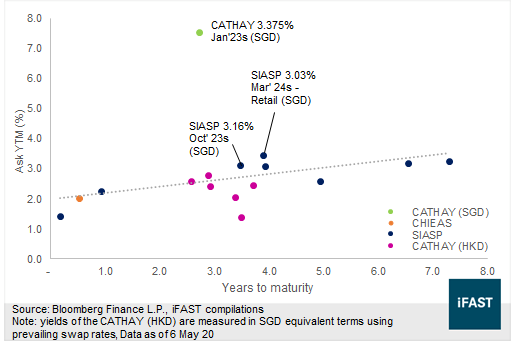
Within the SIASP curve, we think the intermediate part of the curve provides more value for bond investors, or more specifically the maturities between 2023 to 2024: SIASP 3.160% 25Oct2023 Corp (SGD) and the SIASP 3.030% 28Mar2024 Corp (SGD) - Retail. These bonds offer decent yield and spread pick-ups against the other tenors.
The SIASP 3.16% Oct’23s has an ask YTM of 3.11% (Z-spread: 256bps) and offers decent returns against its longer dated bonds with a shorter maturity (see Figure 13). We also note that SIA’s bonds carry YTMs ranging between 1.44% and 3.46% for tenors between 0.2 to 7.3 years. We think these bond yields have largely priced in the positivity of strong shareholder support at times of need and SIA’s leading market position in the aviation sector.
The SIASP 3.03% Mar’24s at its ask YTM of 3.46% (Z-spread: 294bps) based on exchange pricing is also offering the highest yield among SIASP bonds. These bonds are a good alternative for retail investors given the scarcity of retail corporate bonds in the market.
Finally, the indicative pricing of the CEA’s CHIEAS 2.800% 16Nov2020 Corp (SGD) is offering a fair ask YTM of 2.02% (Z-spread: 167bps). We have a balanced view on the CHIEAS 2.8% ‘20s. The 2.02% yield on the notes reflect the state ownership and the importance of the aviation industry to the Chinese government, providing a fair premium for CEA’s tight liquidity and highly-levered balance sheet, albeit on par with its peers Air China and China Southern Airlines.
Turbulence: fasten your seat belt and embrace for landing
All told, airlines investors had been able to enjoy a bull-run (see Figure 1) lifted by healthy travel demand for the past decade. But all those years of growth vaporised within a span of months after a sudden paralysis of operations spurred the question of an airline’s financial viability. Thus, investors who are keen in investing in the aviation industry may need to consider the risks that still linger around the sector.
Our thesis do not incorporate the meaning of discouraging investors from finding investment values in the entire industry, but to do so with informed decision making when identifying ones that have good potential to tide through a turbulence. Certainly, surging airline bond yields represent a good time to invest as air travel will eventually rebound.
We also believe that the recent financial struggles within the sector is a good (and yet another) reminder that reveals the industry’s reliance on funding. In the longer term however, we speculate that the downturn will serve as a lesson for industry players and regulators to think about making changes and reforms so that airlines will resume to its upward growth potential.